A Five-Minute Picture Walk Through One Familiar Room
A five-minute picture walk through one familiar room helps you describe its shapes and visual relationships from one steady viewpoint.
The common mistake in a familiar room is to name its contents—chair, lamp, door—and stop there. A five-minute picture walk through one familiar room costs little attention, but that inventory misses how the room’s visible shapes fit together. The point is not to inspect the furnishings; it is to describe the scene from one steady position.
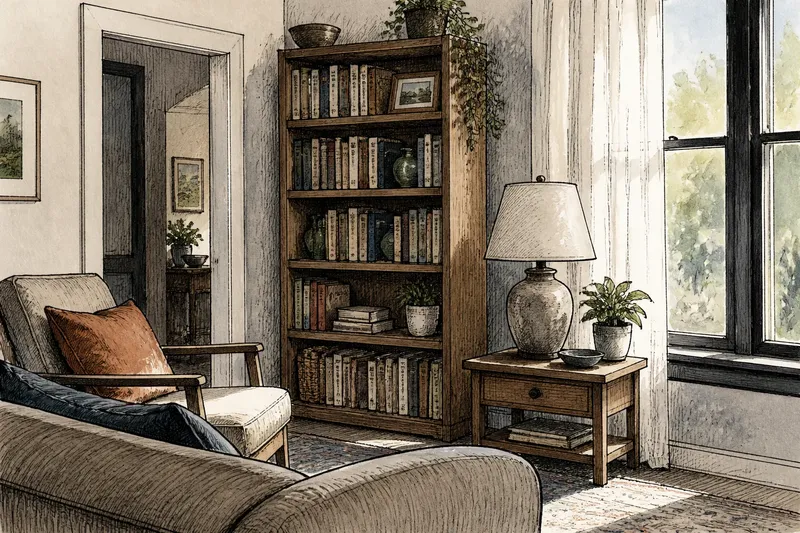
Choose a safe place to sit or stand where you can see part of the room without twisting or blocking a route. Keep that viewpoint for the exercise. Say you sit at the end of a sofa facing a bookcase, window and side table: use that view, rather than shifting about to find a better one.
Set the viewpoint
Let your gaze settle before naming objects. Notice the broad shape of the view: perhaps a wall interrupted by a doorway, or a narrow opening framed by a bookcase. Your eyes can move; your body stays in place.
Use a manageable portion of the room. If the whole scene feels busy, focus on the bookcase and the patch of wall around it. A fixed view makes it easier to compare one visible relationship with another.
Notice the nearest edge
Find the closest visible form or boundary. It could be a chair arm, a table corner, a plant leaf or the edge of a rug. “Nearest” describes its place in the view, not its importance.
Look at what that edge partly hides. A chair back might cover a strip of a cabinet; the interruption shows which form appears in front. Then follow the visible route towards the back of the room, from chair to table to cabinet, for instance.
If no object seems clearly in front, use a boundary such as the doorway edge or the place where rug meets floor. Note one relationship and move on.
Read the shapes
Look for forms that recur without needing to match exactly. Book spines can make a run of narrow upright shapes; chair legs may echo one another; cupboard handles may repeat a small curve. Notice whether the forms sit in a row, gather together or appear apart.
Now find where the pattern changes. A gap between books or a handle turned at another angle can make the repeated shapes easier to see. There is no need to count them: the useful observation is where the likeness begins and where it breaks.
Compare neighbouring areas
Find a place where two adjacent areas differ clearly. A dark coat against a pale wall, a bright lampshade beside a dim shelf, or a firm furniture edge against a soft curtain may catch your eye. The difference can come from shade, colour, texture or outline.
Ask what creates the contrast rather than deciding which object matters most. A remote control may be useful, but a patch of sunlight may be more noticeable in the view. Then glance at a quieter area, such as a plain wall or floor, and see how it sits beside the stronger shapes.
Describe the relationships
Bring together three observations: one nearby form, one recurring shape and one clear contrast. Keep the description tied to what you can point to. “Chair edge in front, upright book spines beyond, bright curtain beside a dark frame” describes the view more precisely than a verdict that the room feels balanced.
Imagine you are seated by a sofa, with a chair arm at the lower edge of your view, upright books on a shelf, and a pale curtain beside a dark window frame. You first note the chair arm, then the repeated book spines, then the curtain-frame contrast. Your resulting description is “chair arm in front; repeated upright spines beyond; pale curtain against dark frame”. If the curtain seems brighter than the shelf only because of the light, leave that comparison uncertain rather than adding a claim the view does not support.
Questions about looking?
Do I need to write anything down?
No. You can name the shapes silently or jot down a few words, such as “near edge, upright forms, light-dark boundary”. The note is there to keep observations distinct, not to become a room report.
What if the room looks cluttered?
Keep your position fixed and narrow the view to one area, such as a shelf and the wall around it. A smaller scene is easier to describe than a room-wide collection of competing details.
Can I repeat the picture walk later?
Yes. Use the same viewpoint another time and see whether your attention settles on a different relationship. The furnishings can stay put while your description changes.
Should I move anything first?
No. The exercise concerns the room as it appears from your chosen position. If the view is unsafe or obstructed, choose another safe position before starting.
Keep the account plain
A picture walk is not a household inspection or a decorating plan. You do not need to label every object or decide whether the room is arranged well. A few precise observations are enough to describe what the eye can see from one position.
For a five-minute picture walk through one familiar room, begin with the nearest visible edge and finish with a plain sentence about its relationship to the other shapes. Leave one uncertain comparison unresolved; a description is more useful when it does not pretend to see more than the view allows.