Repeating Tiles or a Loose Scatter: Two Ways to Organise a Surface
Repeating tiles or a loose scatter can change a tabletop’s visual rhythm. Learn how spacing and small variations shape order, emphasis and grouping.
The common mistake with a tabletop arrangement is to space every object evenly, then wonder why the display looks stiff or oddly accidental. Repeating tiles or a loose scatter offer two clearer ways to organise a surface: regular spacing makes objects read as a system, while informal grouping gives them room to form smaller relationships.
Neither approach is inherently calmer, more attractive or easier to read. The result depends on the objects’ shapes, the gaps between them and the small deviations that tell the eye whether a pattern is deliberate. A bowl, a stack of coasters and a few loose items can look orderly or unsettled with only a modest change in spacing.
Regular repetition
A tiled arrangement relies on a recurring interval. Objects may form rows, a grid or a simple sequence; the gaps between neighbouring items are similar enough for the eye to connect them. The objects do not need to match exactly. Repeated placement supplies the organising rule.
This is useful when several items have similar size and visual weight, such as square coasters or small ceramic dishes. Their repeated edges and steady gaps make the surface read as one arrangement rather than a collection of separate things. A clear rhythm can also make an empty area feel intentional, because the eye can anticipate where the next item would sit.
Exact uniformity can become mechanical. A small difference in angle, colour or object height gives the sequence texture, but too many exceptions weaken the underlying order. A useful distinction is between a pattern with a little variation and an assortment that happens to have similar pieces.
Keep the main interval steady before changing the objects’ orientation.
Informal grouping
A loose scatter has no single repeated interval. Instead, objects gather into small clusters, with wider gaps separating one cluster from the next. The eye reads the near neighbours as related and the larger empty areas as boundaries.
This arrangement suits objects with different forms or uses: a book, a cup, a small dish and a paperweight do not naturally behave like identical tiles. Their proximity can suggest a working group without forcing them into rows. The important point is that “loose” does not mean randomly placed. If every gap and angle differs without any noticeable grouping, the objects may simply compete for attention.
Clusters need enough separation to remain distinct. When two groups nearly touch, the gap between them stops working as a boundary; when the gap is very large, they may seem unrelated. The right spacing depends on the objects’ outlines and on how strongly their colours or materials contrast with the tabletop.
Make the clusters legible before adding more objects.
Spacing and rhythm
Spacing is not blankness. It is part of the arrangement’s visible structure. A row of repeated objects with narrow, consistent gaps feels more connected than the same row with generous intervals. In a scatter, a compact cluster often reads as a unit, while a larger surrounding gap lets that unit stand apart.
Compare the gaps between objects with the gaps around them. If the inner gaps are close to the outer gaps, a cluster may not read as a cluster at all. If the outer space is much wider, the group becomes more distinct. This simple comparison is often more useful than asking whether the objects are “too close” in isolation.
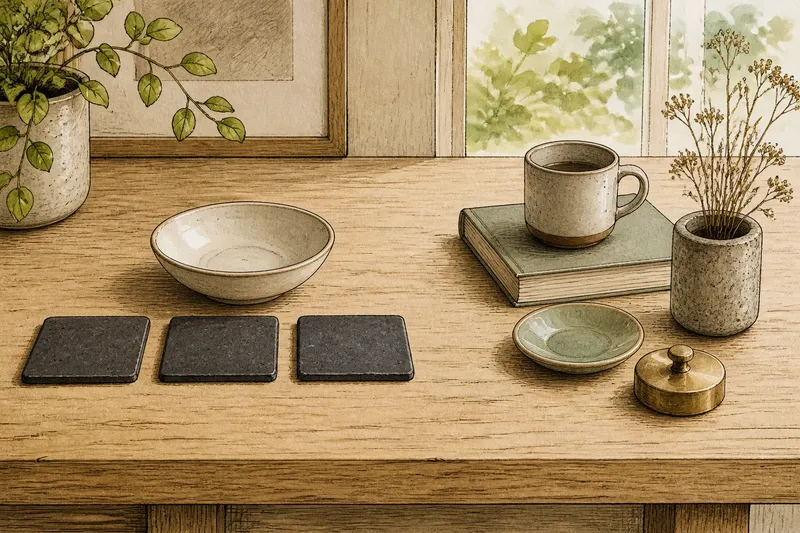
Say you have a pale wooden table, three dark coasters and a shallow white bowl. If you place the coasters at similar intervals in a row and set the bowl apart, the coasters form a repeated sequence and the bowl becomes a separate element. If you bring two coasters close together and leave the third nearer the bowl, the relationships change: one pair is apparent, while the remaining pieces form a looser group. The objects have not changed; the spacing has changed the reading.
Check the arrangement from the place where it is usually seen, not only from directly above. An angle can compress some gaps and widen others, especially on a deep tabletop. A pattern that looks regular overhead may appear uneven from a seated position.
Small variations
Variation gives a repeated arrangement life, but it needs a limit. A slightly rotated coaster or a dish in a different shade can interrupt a sequence without destroying it. If every object has a different angle, distance and colour, the eye has no stable rhythm to return to.
In a loose scatter, variation can help distinguish roles. A tall cup may anchor a group of flatter objects; a round dish can break up a run of rectangular forms. Yet a conspicuous object can dominate even when it occupies little space. Colour contrast, reflective glaze and a sharp outline all increase its visual weight.
Try changing one feature at a time: the interval, the angle or the position of one object. When several features shift at once, it is harder to see which change made the arrangement feel more coherent. This is not a laboratory exercise; it is simply a way to make a visual decision with less guesswork.
Which arrangement fits?
Use repetition when the objects share a clear feature and you want the surface to read as ordered. Use informal grouping when the objects differ and you want their relationships to feel local rather than uniform. A mixed approach is also possible: a row of coasters can sit beside a compact group of unrelated objects, provided the two structures remain distinguishable.
Think about how the arrangement will be used. Frequently handled items may need clear access and a practical place to return to; objects kept mainly for display can tolerate a more deliberate pattern. The visual arrangement should not make ordinary use awkward. A tidy rhythm is less persuasive if reaching for the cup requires a small expedition.
Questions about surface patterns?
How do I make a tabletop arrangement look less cluttered?
Separate objects into recognisable groups and leave a visible gap between groups. If items still compete, remove or relocate one rather than trying to solve every conflict with finer adjustments.
Should repeated objects be exactly the same distance apart?
They need a consistent enough interval for the eye to recognise a sequence, not mathematical precision. Small differences in spacing can keep the pattern from feeling rigid, as long as they do not create an accidental-looking break.
Can different objects form one visual group?
Yes, if proximity or a shared feature makes their relationship clear. Similar material, colour or purpose can link objects, but a close grouping is often the most immediately visible cue.
What should I change first if the arrangement feels unbalanced?
Look at the largest gaps and the object with the strongest visual weight. Adjusting one of those may clarify the whole surface more effectively than moving every item a little.
A useful final adjustment
Before settling on repeating tiles or a loose scatter, look for the pattern made by the empty spaces as well as the objects. A neat row can be undermined by one cramped edge; a scatter can become coherent when its clusters have clear breathing room. The surface is organised by both what is present and what has been left open.
For a quick visual check, step back, let your eyes settle, then notice what they connect first: repeated intervals, a cluster, or one isolated object. If that first reading matches the arrangement’s intended character, the spacing is doing its job. If not, change one gap and look again.