Why a Window Frame Makes a Distant View Feel Layered
See how a window frame makes a distant view feel layered by separating overlap, relative size and detail into clues you can judge without measuring.
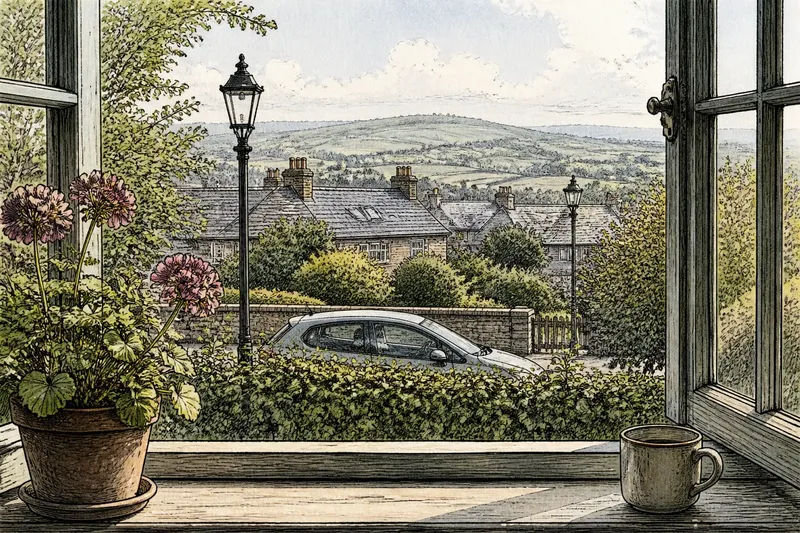
The common mistake when looking through a window is to treat the view as a flat picture with a frame around it. That misses the frame’s useful work: it gives the eye a nearby edge against which more distant objects can be read, and losing that distinction can make a garden, street or hillside seem oddly compressed. A window frame makes a distant view feel layered not by measuring depth, but by setting several visual clues beside one another.
Three clues, separate jobs
Overlap tells you which object is in front. Relative size suggests how far away similar things may be. Changes in detail help distinguish nearby surfaces from distant ones. In a window scene, these clues often cooperate, but they do not mean the same thing.
Imagine a potted plant on the sill partly covering a parked car, with rooftops beyond the car. The plant’s edge interrupts the car, so the plant reads as nearer. The car, in turn, masks part of a rooftop. That succession creates a simple order even if the objects’ actual distances are unknown.
Each clue has limits. A small object might be far away, or simply small; a sharp edge might belong to a distant sign as readily as to a nearby one. Read the relationships, not a single cue as a ruler.
Overlap sets an order
Overlap is usually the clearest clue in a busy view because one contour visibly stops at another. A tree trunk crossing a roofline sits in front of that roofline in the picture’s depth order. The frame itself adds a steady foreground boundary, especially when a latch, mullion or sill is visible.
But overlap only gives a local ranking. If a chimney appears in front of a cloud, that does not tell you how far the chimney is from the house below it. Nor does it sort two objects that do not touch or cross. Use overlap to answer “which is in front here?”, not “how far away is everything?”
When the view feels crowded, follow one interrupted edge at a time.
Size suggests distance
Relative size is most useful when the objects are recognisably alike. Two similar roof vents may project as different sizes; the smaller one can seem farther away. A row of matching garden chairs, seen through an open window, offers a comparable clue if their shapes and orientations remain visible.
Unlike overlap, size can hint at a broader distance relationship, but it depends on a reasonable assumption: the objects are roughly alike in actual size. A large nearby tree and a small distant shed cannot be sorted by apparent size alone. Perspective also changes how much of an object is visible, so compare like with like rather than treating every small shape as remote.
Choose a repeated object, not the most dramatic one, when using size as a clue.
Detail fades unevenly
Near objects often show finer distinctions: leaf edges, brick joints or the grain of a wooden sill. Farther surfaces may merge into broader patches, while small branches and window divisions become harder to separate. This shift in detail can make the view feel like a sequence of planes rather than a collection of cut-outs.
Detail is not a reliable distance scale by itself. A shaded wall may look less distinct than a sunlit roof at a greater distance; mist, glare or dirty glass can soften the whole scene. The useful comparison is between surfaces under broadly similar viewing conditions, such as two stretches of the same hedge.
Look for which details remain distinct, and which have begun to blend.
Which clue suits the view?
The best starting point depends on what the scene gives you. Use overlap when edges cross clearly; compare relative size when similar objects repeat; attend to detail when surfaces recede without many clean intersections. These are viewing approaches, not competing explanations, and a scene may invite more than one.
- Clear crossing edges: start with overlap to establish a near-to-far order.
- Repeated, similar objects: compare apparent size, while checking that the objects are alike.
- Broad surfaces or haze: compare visible detail, but account for light and obstruction.
- Mixed or ambiguous cues: keep the clues separate and leave uncertain distances unresolved.
Say you are looking past a painted window mullion towards two similar lamp posts, with a hedge crossing the lower part of the nearer one. The hedge’s interruption places it in front at that crossing; the smaller-looking post may seem farther than its match; and its softened fittings may support that impression. If the posts differ in size or the light falls differently, the last two clues weaken. The sound choice is to trust the crossing for local order and treat the rest as a cautious reading.
What can the frame tell you?
Does the window frame create depth?
The frame supplies a nearby boundary and can make the outside view read as a scene beyond it. It does not create the distances among the trees, roofs or buildings; their relationships supply those clues.
Why do objects overlap in a view?
From one viewing position, a nearer object can cover part of a farther one. The covered contour helps establish which object lies in front at that location, but it does not reveal the gap between them.
Does a smaller object always seem farther away?
No. Relative size is informative mainly when the objects are similar in actual size and viewed in comparable ways. Different object sizes can make a nearer thing look smaller than a distant one.
Why does distance reduce visible detail?
Fine features become harder to distinguish as they occupy less of the view, and intervening air or glass can soften edges. Lighting, shade and surface contrast also affect how much detail appears, so softness alone does not settle the question.
Leave room for uncertainty
A window scene is easiest to read when its clues are allowed to do different jobs. Overlap provides a local front-to-back order, relative size offers a comparison among similar forms, and changing detail suggests how surfaces recede. None gives a complete account of depth on its own.
For a more careful look at why a window frame makes a distant view feel layered, shift your gaze from the nearest visible edge to one crossing, one repeated form and one receding surface. The useful result is not a numerical distance, but a clearer sense of which relationships the scene supports—and which it leaves open.